Contents
In short: when you press Enter in Claude Code, your prompt leaves your computer as one request, together with its context: the chat so far, instructions, tools and the files it has read. It goes over HTTPS to Anthropic's API, possibly across an ocean in an undersea cable, to a data centre where AI chips run the model. The answer streams back token by token. Sometimes the answer is a request to read a file or run a command on your machine; Claude Code runs it, after asking where it's set to ask, and sends the result back. That loop is the agent.
One request, more than your prompt
Claude Code runs on your machine: in Anthropic's words, it "reads your codebase, edits files, runs commands, and integrates with your development tools." When you press Enter, it sends a request to the Claude API, a RESTful API at https://api.anthropic.com, over HTTPS.
That request carries more than what you typed. Everything in it counts toward the model's context window: "the system prompt, every message in messages (including tool results, images, and documents), and your tool definitions."
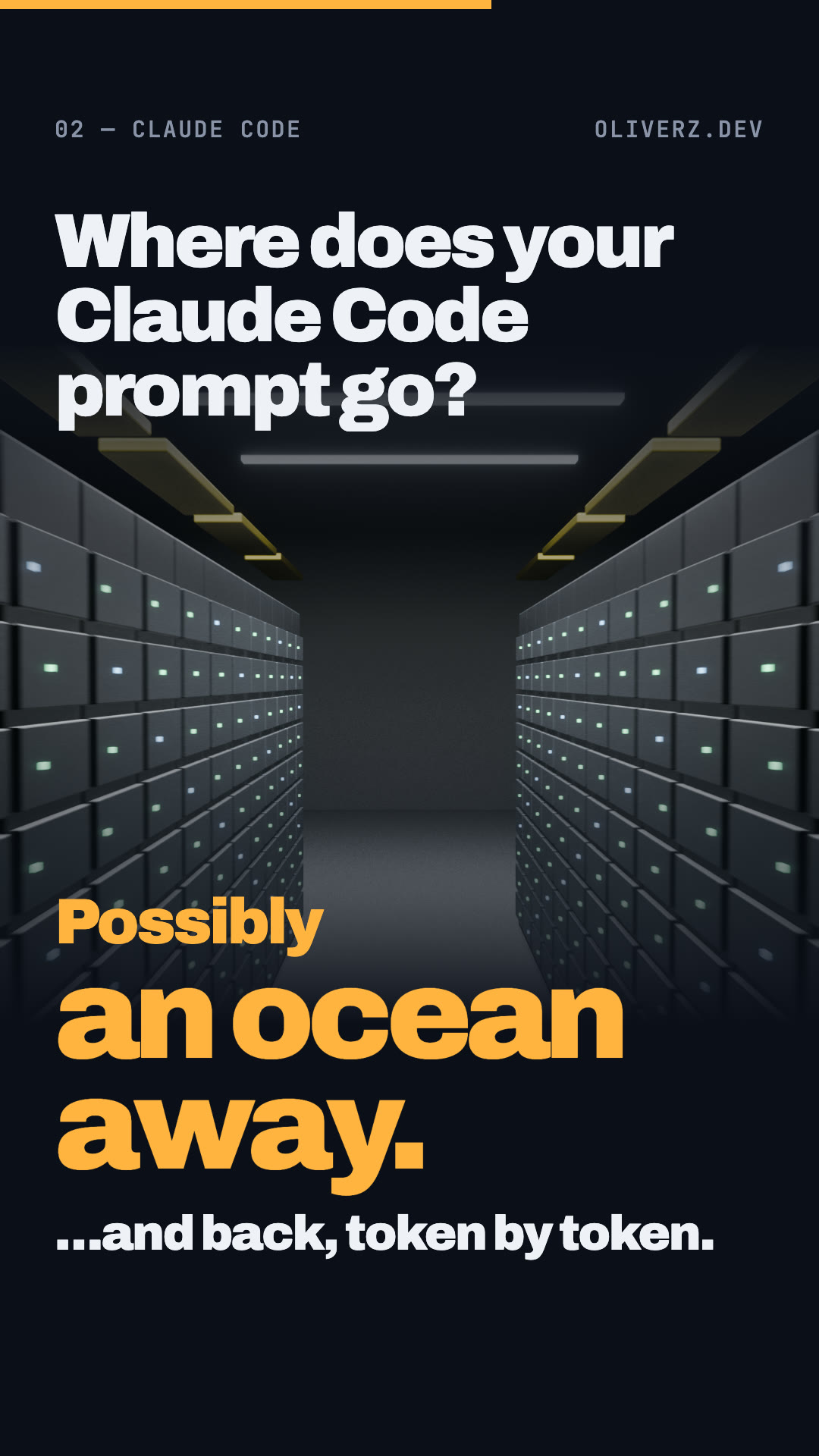
Across an ocean, possibly
From your router and your internet provider, the request travels the internet to wherever the model runs. Between continents, that usually means a cable on the seabed: TeleGeography puts submarine cables at "over 99%" of intercontinental data traffic (satellite traffic can't be measured precisely).
Where it lands isn't always nearby. By default, Anthropic's API says "inference may run in any available geography"; only the us setting keeps it in US-based infrastructure. So the data centre may be an ocean away.
Chips, layers, tokens
In the data centre, AI chips run the model. Anthropic trains and runs Claude on "AWS Trainium, Google TPUs, and NVIDIA GPUs". The model works out its reply one token at a time (the video draws it as stacked layers: an illustration, not the real architecture).
The answer doesn't wait until it's finished. With streaming, the API sends it "incrementally … using server-sent events (SSE)", so each token travels back the same way as it's written.
The loop is the agent
Sometimes what comes back isn't text but a request to do something: read a file, run a command. In the API's terms, Claude replies with a tool_use block, "your code runs the operation and sends back a tool_result". Here, your code is Claude Code, on your machine.
It asks first. In its default manual mode, Claude Code asks before running Bash commands (except a built-in set of read-only ones) and before modifying files. You approve, it runs on your machine, and the result goes back as the next request. Again and again until the task is done: that loop is the agent.
Takeaway
Claude Code is a loop between your machine and a model in a distant data centre. Anything that runs on your machine runs there because Claude Code ran it, after asking where it's set to ask.
Sources
- Anthropic, Claude Code overview
- Anthropic, Claude Code permissions
- Anthropic, API overview
- Anthropic, Context windows
- Anthropic, Data residency
- Anthropic, Streaming
- Anthropic, Tool use overview
- Anthropic, Google and Broadcom partnership on compute
- TeleGeography, Mythbusting, part 3
The video is animated with code (rendered in Blender) and the script was written with AI assistance; every fact above is checked against the sources. Illustrative: the route (one provider, one cable, one data centre), the model as stacked layers, and the text on the screen. This is an independent explainer, not affiliated with Anthropic. Made with Shotloop, my free Mac app for code-made explainers, fixed one shot at a time.