Contents
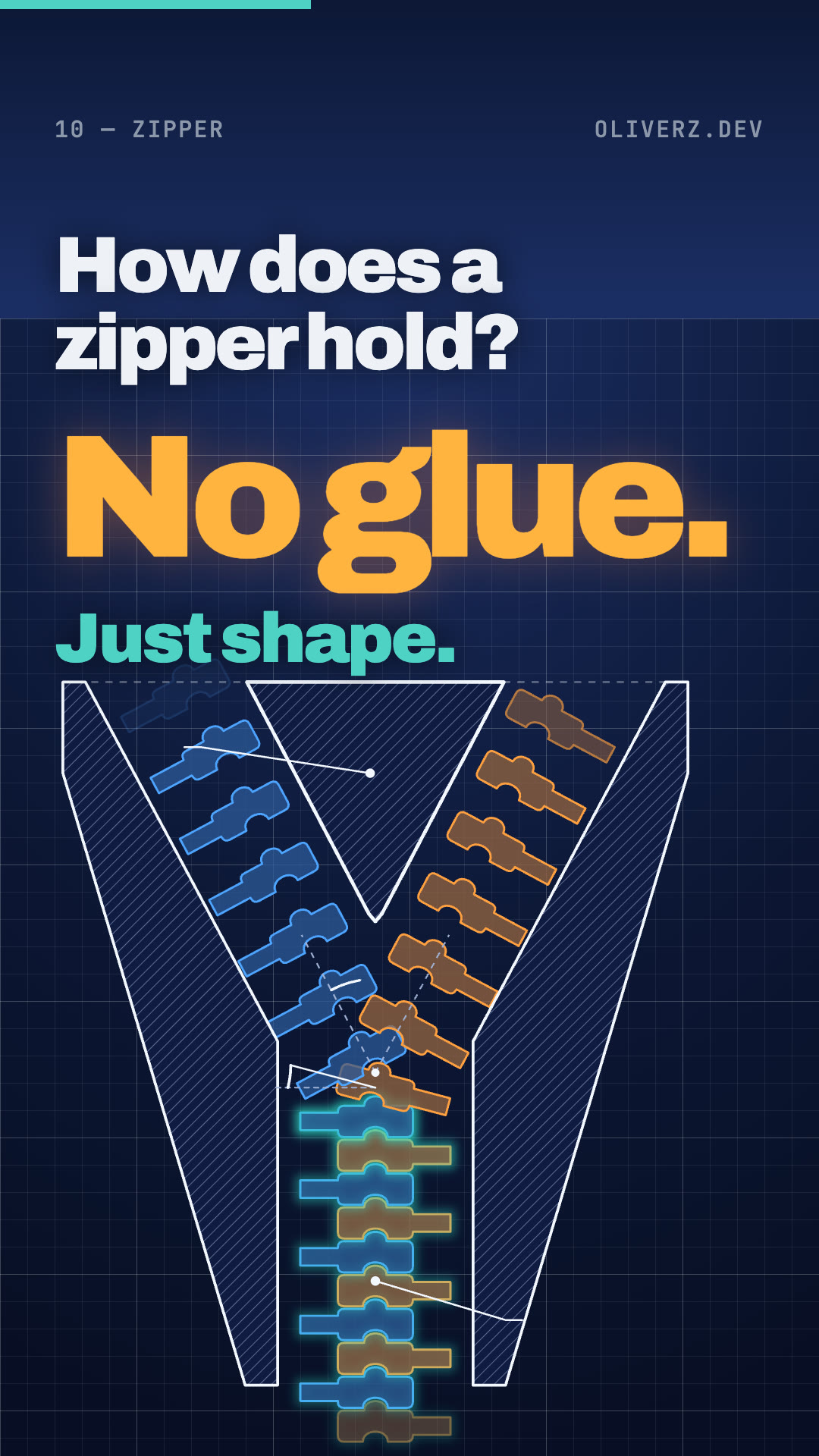
In short: a zipper has no glue and no magnets. Every tooth has a bump on one side and a hollow on the other, the two rows are offset by half a tooth, and the slider's Y-shaped channel squeezes them together so each bump nests in the next tooth's hollow. Pull the slider back and they come apart again. Gideon Sundback patented this design in 1917, and YKK alone makes more than 3 million km of zipper a year.
One tooth: a bump and a hollow
Gideon Sundback's patent, US 1,219,881 ("Separable Fastener"), describes the teeth in its first claim: "interlocking members secured at one end thereto in staggered relation, each member having at the free end a rounded recess on one side and a corresponding projection on the opposite side".
A single tooth holds nothing on its own. The shape only works in a row.
Two rows, half a tooth apart
The same claim: "the members on one stringer alternate with those on the other". Offset by half a tooth, every bump on one side faces a hollow on the other.
The slider presses them together
The slider "consists of two stamped sides each having a Y-shaped channel forming a tongue". As it runs up, the two arms of the Y bring the rows together, and the patent describes the result: "the outside of one member nests within the recess of an adjoining member when in locked relation".
Opening it
Run the slider back and the rows come apart again, one tooth at a time. The patent names the part between the two channels "a tongue"; the video shows it as a small wedge between the rows.
Patented in 1917
US 1,219,881 was filed on 27 August 1914 and issued on 20 March 1917.
The scale
YKK Group's "This is YKK 2025" report puts its zipper output for the 2024 fiscal year at "More than 3 million km (FY2024)", and adds: "Enough to encircle the earth 80 times".
Takeaway
- A zipper holds by shape: a bump nesting in a hollow, tooth after tooth.
- The offset rows and the slider's Y do all the work; the teeth never move on their own.
- The design is more than a century old and is made by the millions of kilometres.
Sources
- G. Sundback, US Patent 1,219,881, "Separable Fastener", issued 20 March 1917
- YKK Group, This is YKK 2025, October 2025, p. 10
The video is animated with code and the script was written with AI assistance; every quote above is checked against the patent and the report. Illustrative: the drawings follow the patent's description, not its figures, and the wedge's motion is shown, not quoted. The video is narrated in English. Made with Shotloop, my free Mac app for code-made explainers, fixed one shot at a time.