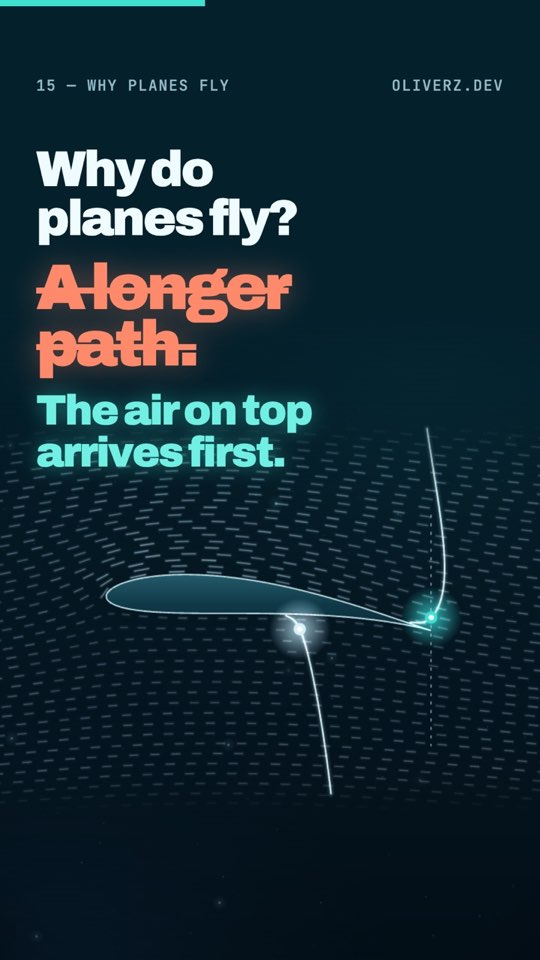
一句话总结: 我们大多数人学到的说法是:机翼上表面更长,所以上面的空气必须更快,才能在后缘和下面的空气会合。NASA 称它是流传最广的错误升力解释之一。其实没有什么让两股空气会合:在风洞里,上面的空气远比下面的空气先到达后缘;平的纸飞机机翼和倒飞的飞机也一样有升力。真正发生的是:机翼的形状和倾角把空气往下拐,空气则把机翼往上推。从压力的角度看,就是机翼上方压力低、下方压力高:同一个升力的两种描述,所以伯努利和牛顿都是对的。
我们大多数人学到的说法
NASA 格伦研究中心:"The theory described on this slide is one of the most widely circulated, incorrect explanations. The theory can be labeled the “Longer Path” theory, or the “Equal Transit Time” theory."(这页幻灯片描述的理论,是流传最广的错误解释之一。它可以称为"路程更长"理论,或"等时通过"理论。)
它的内容是:"The air molecules (the little colored balls on the figure) have farther to travel over the top of the airfoil than along the bottom. In order to meet up at the trailing edge, the molecules going over the top of the wing must travel faster than the molecules moving under the wing."(空气分子(图中的彩色小球)从翼型上方经过的路程比从下方经过的更远。为了在后缘会合,从机翼上方经过的分子必须比从下方经过的分子跑得更快。)
而且它无处不在。剑桥大学的 Holger Babinsky 教授:"You find it taught in textbooks, explained on television and even described in aircraft manuals for pilots."(你会发现教科书里在教它,电视上在讲它,连给飞行员的飞机手册里都这么写。)
没有什么让它们会合
NASA 格伦:"This part of the theory attempts to provide us with a value for the velocity over the top of the airfoil based on the non-physical assumption that the molecules meet at the aft end."(这部分理论试图给出翼型上方的流速,依据的却是分子在后端会合这一不符合物理的假设。)还有:"Two molecules near each other at the leading edge will not end up next to each other at the trailing edge"(在前缘彼此相邻的两个分子,到了后缘并不会仍然相邻)。
在风洞里,上面的空气先到
剑桥大学,2012 年:"Babinsky filmed pulses of smoke flowing around an aerofoil … When the video is paused, it’s clear that the transit times above and below the wing are not equal: the air moves faster over the top surface and has already gone past the end of the wing by the time the flow below the aerofoil reaches the end of the lower surface."(Babinsky 拍下了一股股烟流过翼型的画面……把视频暂停就能清楚看到,机翼上下的通过时间并不相等:上表面的空气流得更快,等到翼型下方的气流到达下表面末端时,上面的空气早已越过了机翼的末端。)
NASA 格伦也这么说:"particles moving over the top arrive at the trailing edge before particles moving under the airfoil."(从上方经过的粒子比从翼型下方经过的粒子先到达后缘。)
平的机翼和倒飞的飞机也有升力
NASA 格伦:"Think of a paper airplane. Its airfoil is a flat plate –> top and bottom exactly the same length and shape and yet they fly just fine."(想想纸飞机。它的翼型是一块平板,上下表面长度和形状完全相同,可它飞得好好的。)
还有:"This theory also does not explain how airplanes can fly upside-down which happens often at air shows and in air-to-air combat. The longer surface is then on the bottom!"(这个理论也解释不了飞机为什么能倒飞,而这在飞行表演和空战中很常见。那时更长的表面在下面!)
真正发生的是:机翼让空气拐弯
NASA 格伦,《What is Lift?》:"Lift occurs when a moving flow of gas is turned by a solid object. The flow is turned in one direction, and the lift is generated in the opposite direction, according to Newton’s Third Law of action and reaction."(当流动的气体被固体改变方向时,就产生了升力。气流被拐向一个方向,升力就在相反的方向产生,依据的是牛顿第三定律,即作用与反作用。)还有:"For an aircraft wing, both the upper and lower surfaces contribute to the flow turning."(对飞机机翼来说,上下两个表面都参与让气流拐弯。)
让气流拐弯的,是机翼的形状和倾角。NASA 格伦:"The magnitude of the lift generated by the wing depends on the shape of the wing and how it moves through the air."(机翼产生的升力大小,取决于机翼的形状以及它在空气中如何运动。)还有:"The angle between the chord line of the airfoil and the flight direction is called the angle of attack. Angle of attack has a large effect on the lift generated by a wing."(翼型的弦线与飞行方向之间的夹角叫作迎角。迎角对机翼产生的升力影响很大。)
Babinsky:"What actually causes lift is introducing a shape into the airflow, which curves the streamlines"(真正产生升力的,是在气流中放入一个形状,它让流线弯曲)。
从压力看,是同一个升力
Babinsky 把结果描述为 "lower pressure on the upper surface and higher pressure on the lower surface"(上表面压力较低,下表面压力较高)。
那个说法说上面的空气更快,这一点没错;错的是速度。NASA 格伦:"Experiment #1 shows us that the flow over the top of a lifting airfoil does travel faster than the flow beneath the airfoil. But the flow is much faster than the speed required to have the molecules meet up at the trailing edge."(实验 1 表明,产生升力的翼型上方的气流确实比下方的快。但它比让分子在后缘会合所需的速度快得多。)还有:"The upper flow is faster and from Bernoulli’s equation the pressure is lower. … this part of the theory is correct."(上方气流更快,由伯努利方程可知压力更低……这部分理论是对的。)
伯努利和牛顿都对
NASA 格伦,《Bernoulli and Newton》:"From Newton’s third law of motion, a turning action of the flow will result in a re-action (aerodynamic force) on the object. So both “Bernoulli” and “Newton” are correct."(根据牛顿第三运动定律,让气流拐弯的作用会在物体上产生反作用(气动力)。所以"伯努利"和"牛顿"都是对的。)
还有:"Newton’s laws of motion are statements concerning the conservation of momentum. Bernoulli’s equation is derived by considering conservation of energy. So both of these equations are satisfied in the generation of lift; both are correct."(牛顿运动定律讲的是动量守恒,伯努利方程是从能量守恒推导出来的。所以产生升力时,这两个方程都成立;两者都对。)
结论
- "路程更长"的说法是错的:没有什么让机翼上下的空气重新会合,上面的空气先到。
- 升力来自让空气拐弯:形状和倾角把气流往下拐,空气就把机翼往上推。
- 上方压力低、下方压力高,是从另一个角度看同一个升力:伯努利和牛顿都对。所以平的机翼和倒飞的飞机也能飞。
来源
- NASA Glenn Research Center,Beginner's Guide to Aeronautics,Equal Transit Theory Interactive(错误的升力理论)
- NASA Glenn Research Center,What is Lift?
- NASA Glenn Research Center,Bernoulli and Newton
- NASA Glenn Research Center,Effects of Inclination on Lift Interactive
- 剑桥大学,How wings really work(Holger Babinsky 教授,工程系),2012 年 1 月 25 日
视频用代码制作动画,脚本在 AI 辅助下撰写;上面每条引文都对照出处核实过。示意部分:气流(流线、烟团、压力的明暗和箭头)是用教科书里的理想流模型算出来的,不是测量的,所以它展示的是规律,不是真实机翼的数值;烟团是我们按 Babinsky 风洞里的烟画的,不是他的录像;飞机都是通用的示意图。视频为英文旁白。视频用 Shotloop 制作:我做的免费 Mac 应用,用代码做科普短视频,一个镜头一个镜头地改。