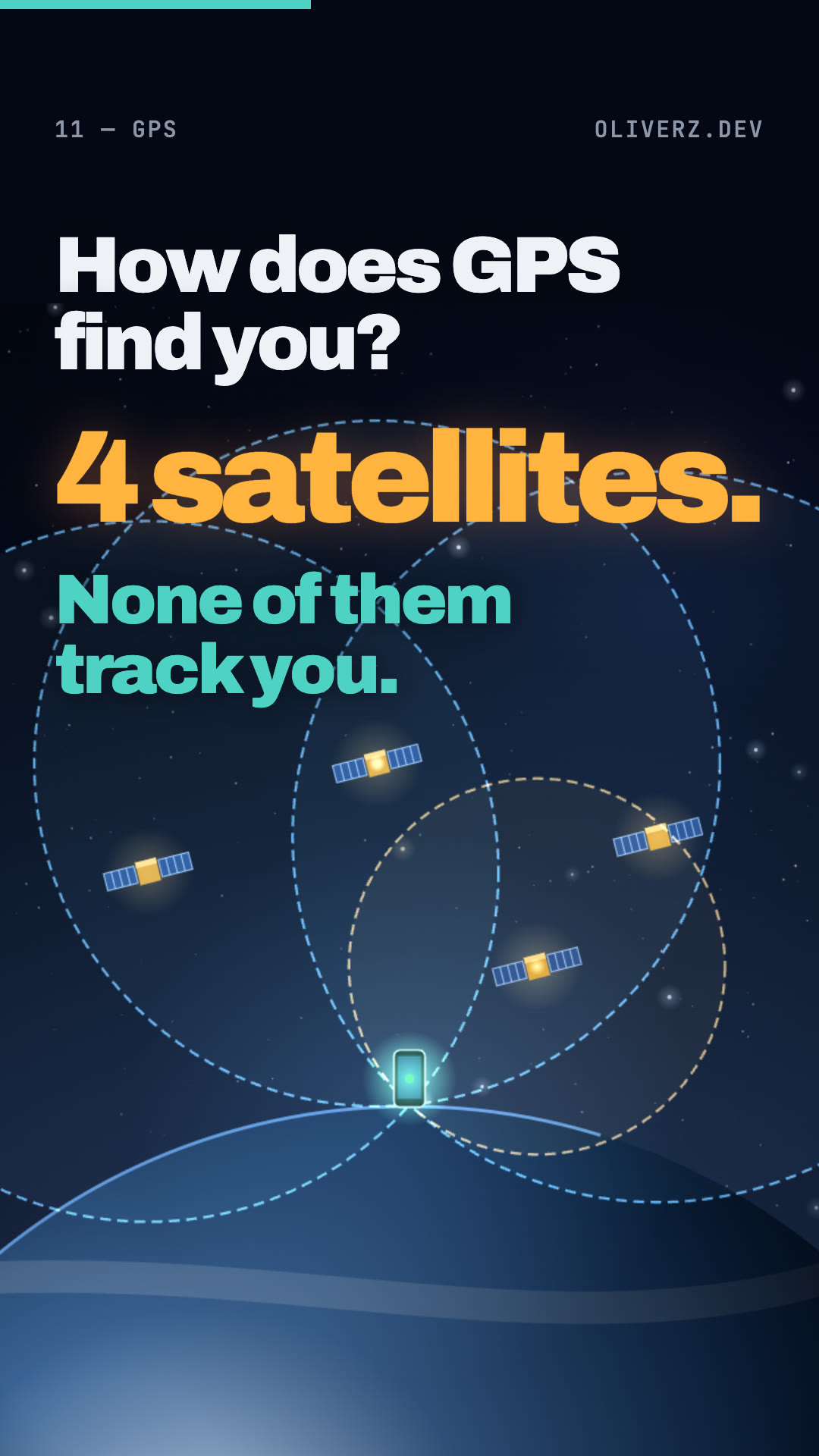
一句话总结: GPS 卫星不追踪任何人。大约 30 颗卫星在约 20,200 公里的高空运行,搭载原子钟,不停广播自己在哪里、现在几点。你的手机只是在听:每个信号的延迟乘以光速就是一段距离,三段距离交于一点,第四颗卫星则用来校正手机那块精度差得多的时钟。由于相对论,卫星上的时钟走得偏快,所以在发射前就已调好。在开阔的天空下,智能手机的定位误差大约在 4.9 米以内。
卫星什么也不追踪
gps.gov 的常见问题:"GPS satellites themselves do not track anything on the ground. They are simply beacons, like lighthouses, broadcasting one-way reference signals."(GPS 卫星本身并不追踪地面上的任何东西。它们只是信标,就像灯塔一样,单向广播参考信号。)
大约 30 颗卫星,高 20,200 公里
gps.gov 介绍空间段时说:"the U.S. Space Force has been flying 31 operational GPS satellites for well over a decade"(十多年来,美国太空军一直在运行 31 颗在役 GPS 卫星),以及 "GPS satellites fly in medium Earth orbit (MEO) at an altitude of approximately 20,200 km (12,550 miles). Each satellite circles the Earth twice a day."(GPS 卫星在中地球轨道(MEO)上运行,高度约 20,200 公里(12,550 英里)。每颗卫星每天绕地球两圈。)
每颗卫星都搭载 "multiple atomic clocks that contribute very precise time data to the GPS signals"(多台原子钟,为 GPS 信号提供非常精确的时间数据),而信号 "give the current GPS satellite position and time"(给出 GPS 卫星当前的位置和时间)。
延迟 × 光速 = 距离
ESA:"The signal emitted from each satellite is a microwave radio wave containing the time it was transmitted and the satellite's current orbital position."(每颗卫星发出的信号是一束微波无线电波,其中包含发射时间和卫星当前的轨道位置。)从 20,200 公里外发来的信号大约要 0.067 秒才能到达(我们自己算的:20,200 km ÷ 299,792 km/s),这段延迟乘以光速,就是距离。
三段距离交汇于你,第四颗卫星校准时钟
还是 ESA:"Three are used to 'trilateralise' (the three-dimensional equivalent of triangulation) the user's longitude, latitude and altitude and a fourth to determine the time offset between the (precise) satellite clock and the (less precise) clock embedded within the receiver."(其中三颗用于对用户的经度、纬度和高度进行"三边测量"(三角测量在三维空间中的对应方法),第四颗则用于确定(精确的)卫星时钟与接收机内置(精度较低的)时钟之间的时间偏差。)
时钟很关键:百万分之一秒的误差大约就是 300 米(我们自己算的:299,792 km/s × 10⁻⁶ s)。
爱因斯坦的修正
在轨道上,卫星的时钟每天大约快 38 微秒。R. Pogge(俄亥俄州立大学):"by about 38 microseconds per day (45-7=38)!"(每天大约快 38 微秒(45-7=38)!)N. Ashby(《Living Reviews in Relativity》,2003)给出的净偏差是 −4.4647 × 10⁻¹⁰:"the standard clock in orbit is beating too fast"(在轨的标准时钟走得太快了)。所以这些时钟在发射前就被调慢,设为 10.22999999543 MHz,而不是 10.23 MHz。
Ashby 在《Physics Today》(2002)中写道:"If these relativistic effects were not corrected for, satellite clock errors building up in just one day would cause navigational errors of more than 11 km, quickly rendering the system useless."(如果不校正这些相对论效应,仅仅一天累积的卫星时钟误差就会造成超过 11 公里的导航误差,系统很快就会变得毫无用处。)
大约五米
gps.gov:"GPS-enabled smartphones are typically accurate to within a 4.9 m (16 ft.) radius under open sky… However, their accuracy worsens near buildings, bridges, and trees."(在开阔的天空下,支持 GPS 的智能手机通常能精确到半径 4.9 米(16 英尺)以内……不过,在建筑物、桥梁和树木附近,精度会变差。)
结论
- GPS 是单向的:卫星广播,手机接听。
- 时间就是距离:来自四颗卫星的延迟,定出你在哪里,以及现在几点。
- 爱因斯坦很重要:卫星的时钟在发射前就为相对论做了校准。
来源
- gps.gov:FAQ、Space Segment、GPS and telling time、GPS accuracy
- ESA(欧洲空间局),How satellite navigation works
- N. Ashby,"Relativity and the Global Positioning System",Physics Today 55(5),2002 年 5 月;"Relativity in the Global Positioning System",Living Reviews in Relativity 6:1,2003 年
- R. Pogge,"Real-World Relativity: The GPS Navigation System",俄亥俄州立大学(Ohio State University)
视频用代码制作动画,脚本在 AI 辅助下撰写;上面每条引文都对照出处核实过,标注"我们自己算的"的两个数字是我们自己的计算。示意部分:卫星、信号脉冲和距离球面(画成圆)。视频为英文旁白。视频用 Shotloop 制作:我做的免费 Mac 应用,用代码做科普短视频,一个镜头一个镜头地改。