Contents
In short: GPS satellites don't track anyone. About 30 of them, roughly 20,200 km up and carrying atomic clocks, broadcast where they are and what time it is. Your phone only listens: each signal's delay times the speed of light is a distance, three distances meet at one point, and a fourth satellite corrects the phone's far less precise clock. The satellites' clocks run fast because of relativity, so they are tuned before launch. A smartphone ends up within about 4.9 m under open sky.
The satellites track nothing
From gps.gov's FAQ: "GPS satellites themselves do not track anything on the ground. They are simply beacons, like lighthouses, broadcasting one-way reference signals."
About 30 satellites, 20,200 km up
gps.gov, on the space segment: "the U.S. Space Force has been flying 31 operational GPS satellites for well over a decade", and "GPS satellites fly in medium Earth orbit (MEO) at an altitude of approximately 20,200 km (12,550 miles). Each satellite circles the Earth twice a day."
Each carries "multiple atomic clocks that contribute very precise time data to the GPS signals", and the signals "give the current GPS satellite position and time".
Delay × the speed of light = distance
ESA: "The signal emitted from each satellite is a microwave radio wave containing the time it was transmitted and the satellite's current orbital position." From 20,200 km away a signal takes about 0.067 s to arrive (our arithmetic: 20,200 km ÷ 299,792 km/s), and that delay times the speed of light is the distance.
Three distances meet at you, a fourth fixes the clock
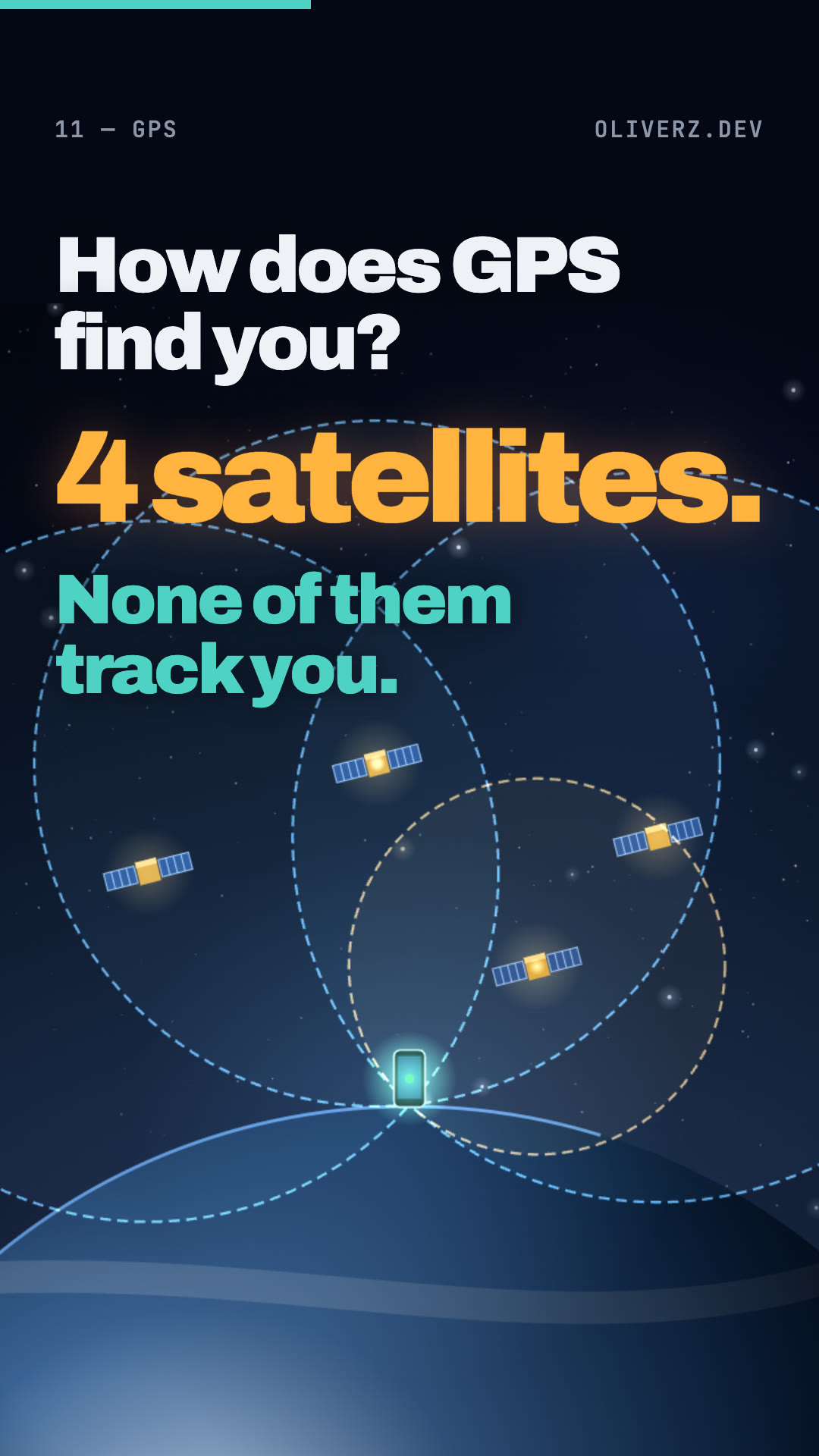
ESA again: "Three are used to 'trilateralise' (the three-dimensional equivalent of triangulation) the user's longitude, latitude and altitude and a fourth to determine the time offset between the (precise) satellite clock and the (less precise) clock embedded within the receiver."
The clock matters: a millionth of a second of error is about 300 m (our arithmetic: 299,792 km/s × 10⁻⁶ s).
Einstein's correction
In orbit the satellites' clocks gain about 38 microseconds a day. R. Pogge (Ohio State): "by about 38 microseconds per day (45-7=38)!" N. Ashby (Living Reviews in Relativity, 2003) gives the net offset as −4.4647 × 10⁻¹⁰: "the standard clock in orbit is beating too fast". So the clocks are set slow before launch, to 10.22999999543 MHz instead of 10.23 MHz.
Ashby in Physics Today (2002): "If these relativistic effects were not corrected for, satellite clock errors building up in just one day would cause navigational errors of more than 11 km, quickly rendering the system useless."
About five metres
gps.gov: "GPS-enabled smartphones are typically accurate to within a 4.9 m (16 ft.) radius under open sky… However, their accuracy worsens near buildings, bridges, and trees."
Takeaway
- GPS is one-way: the satellites broadcast, your phone listens.
- Time is distance: delays from four satellites fix where you are, and when.
- Einstein matters: the satellites' clocks are tuned for relativity before launch.
Sources
- gps.gov: FAQ, Space Segment, GPS and telling time, GPS accuracy
- ESA, How satellite navigation works
- N. Ashby, "Relativity and the Global Positioning System", Physics Today 55(5), May 2002; "Relativity in the Global Positioning System", Living Reviews in Relativity 6:1, 2003
- R. Pogge, "Real-World Relativity: The GPS Navigation System", Ohio State University
The video is animated with code and the script was written with AI assistance; every quote above is checked against its source, and the two figures marked "our arithmetic" are ours. Illustrative: the satellites, the signal pulses and the distance spheres (drawn as circles). The video is narrated in English. Made with Shotloop, my free Mac app for code-made explainers, fixed one shot at a time.